Week 8 Learning

This week in AP Biology, we covered structures of cells, organelles within the cell, and cell transport.

The basic support for the cell is made up of microtubules, microfilaments, and intermediate microfilaments, which is called the cytoskeleton. The cytoskeleton has the functions of cell shape, anchorage of organelles, regulations of cell and organelle motility, transportation, and movement of the cell through space.

We also looked up information about the different organelles, including their size, structure, function, and where they are found.

The cell membrane acts as boundary for the cell. Then we can talk about the plant cell having a cell wall. It is only present to maintain structure. Humans don’t have these because our cells require movement, and cells can be stiff.
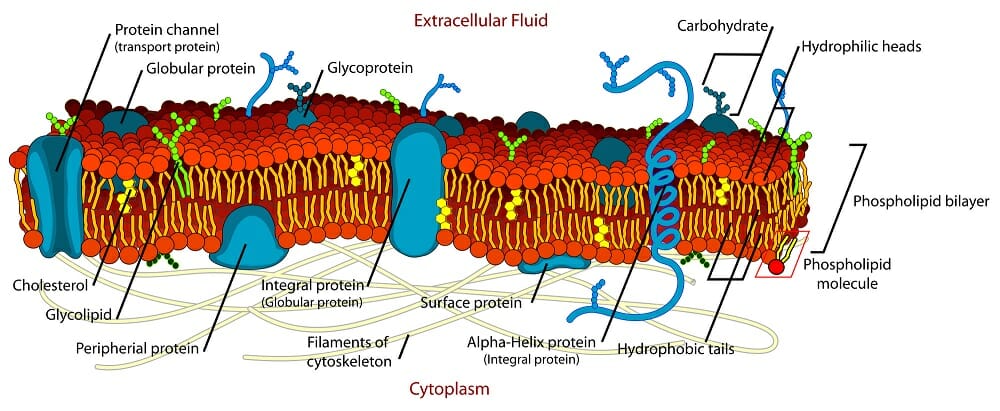
Image result for cell membrane

Lastly, we discussed cell transport. Within cell transport, there is passive transport as well as active transport. We looked at examples of both of these. This week’s topics relate  mostly to Big Idea 2 due to the constant movement of molecules across certain membranes.

This week I was curious and did not understand how cells really link, but now I understand that there is so much support that goes into making a cell come together.


Helpful Resources:

https://www.brightstorm.com/science/biology/cell-functions-and-processes/cell-transport/https://alevelnotes.com/notes/biology/cells/cell-structure/organelle-structure-and-functionchttps://www.ck12.org/biology/cell-transport/lesson/Cell-Transport-Advanced-BIO-ADV/

Week 6 Learning

This week in AP Bio we started chapter 2 which is on chemistry. Most of it was review and we talked about energy, atoms, bonds, and water polarity. This connects with Big Idea 2.B, which states “Growth, reproduction and dynamic homeostasis require that cell create and maintain internal environments that are different from their external environments.”

Lecture: Bio- Chemistry 

Energy and Atoms

  • Atoms: the smallest fundamental unit of matter.
    • 120 different kinds of atoms (“elements”)
    • Biology is made up of 4 major, 10 minor.
  • Energy interacts with atoms in different ways.
    • Holds e-‘s to nucleus
    • When atoms absorb energy, e-‘s move to higher energy levels
    • The movement of e-‘s back to lower energy levels releases energy.

Atoms Bond

  • Bonding is accomplished by electrons interacting between atoms due to valence considerations. Two major kinds of bonds hold atoms together.
    • Ionic bond
      • Transfer of e-‘s
      • Not many combinations.
      • Example is salt, or, NaCl.
    • Covalent bond
      • Sharing of e-‘s
      • Infinite combinations
      • All important biological molecules are covalently bonded.
      • Example is glucose and DNA
  • Not all Bonds are created equal.
    • Polarity: the unequal sharing of electrons in a covalent bond leads to unequal distribution of charge in molecule. Polar molecules are attracted to other polar molecules.
    • Hydrogen Bonds: The strongest attraction between most polar molecules. Common in biological systems.
  • Bonds determine shape.
    • Shape is important.
    • Structure and function closely related.
  • All chemical reactions result in breaking and forming bonds. In any reaction, mass, energy, and charge are conserved.
    • 2H2 O2 = H20

Compounds and Emergence

  • The properties of a compound can be very different from properties of elements that make them.
  • Emergence: Increasing levels of complexity in a system can demonstrate novel properties not seen in the levels below them.
    • Example: Salt

Radioactivity

  • Atoms with unstable nuclei are “radioactive.”
  • Emit high energy particles until stability is reached.

Big Questions

  • Why is water such a big deal?
    • In our bodies, we are water
    • Earth has water
    • Unique properties such as polarity and hydrogen bonds.
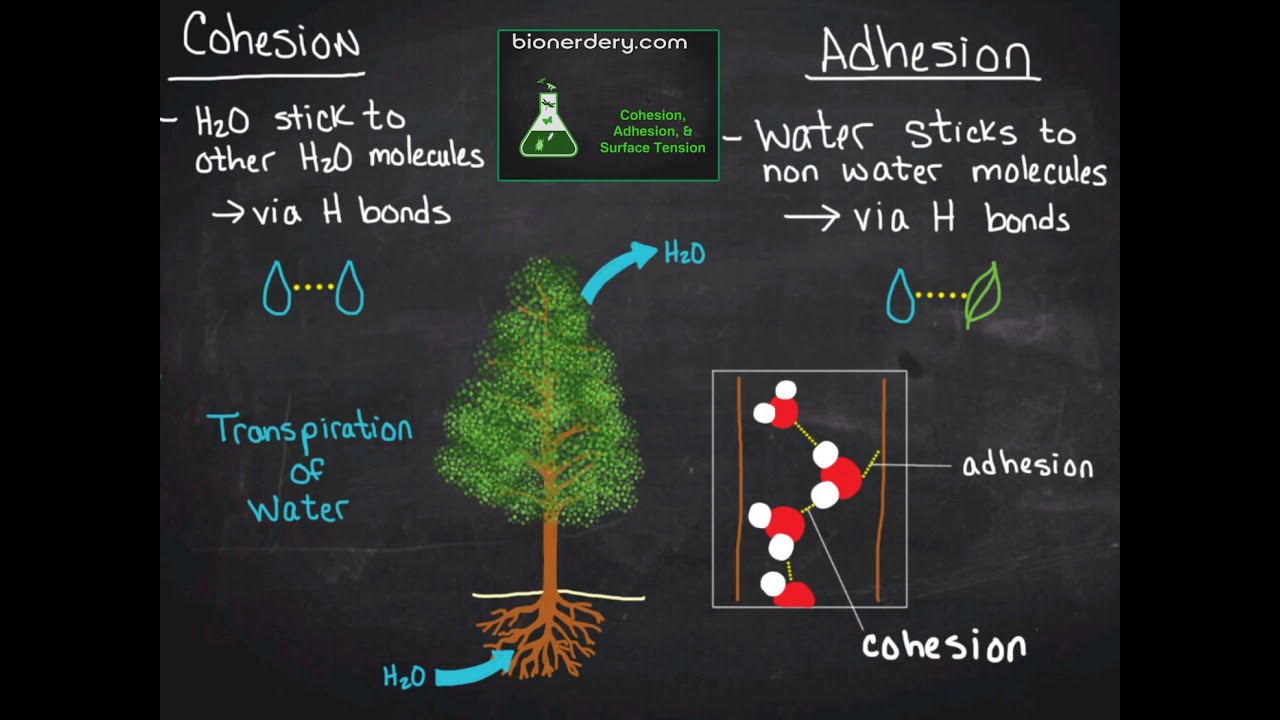
  • Cohesion: sticking together
  • Adhesion: Sticking to other things
  • Water is both cohesive and adhesive, which gives water high surface tension.

Image result for cohesion vs adhesion

A High Specific Heat

  • Specific heat: How much heat is absorbed/ released before an increase/ decrease in temperature.
  • There is no universal solvent but water comes close.

Reflection/ Questions

  1. How does the cohesion and adhesion of water help us?
  2. Are there other solvents that are as good/universal as water?

Helpful Links

https://www.khanacademy.org/science/biology/chemistry–of-life

Week 5 Learning


This week in biology we finished the Hardy-Weinberg population genetics lab and started our plant lab on artificial selection. The main focus of the week was speciation.

LECTURE: SPECIATION

  • Species: Members who interbreed and make viable offspring
  • Morphological: based on appearance
  • Ecology: based on niche
  • Paleological: based on fossils
  • Allopatric: Geographic barriers
  • Sympatric: Same area where species evolve for each otherImage result for speciation types allopatric vs sympatric


REFLECTION

  • Related to big idea number 1
    • The process of evolution drives the diversity and unity of life.
    • Speciation and extinction have occurred throughout the Earth’s history, speciation may occur when two populations become reproductively isolated from each other, and populations of organisms continue to evolve.
  • Speciation happens in nature, but scientists aren’t exactly sure how.
  • The idea of slow change over time is more excepted than the idea of rapid change followed by long periods of no change.

QUESTIONS

  • How was speciation discovered?
  • Can either theory of it be proved?

Helpful Links:

https://globalchange.umich.edu/globalchange1/current/lectures/speciation/speciation.html

Week 3 Learning

This week in biology we continued to learn about evolution mostly through lectures, and worksheets.

LECTURE: EVIDENCE FOR EVOLUTION

  • Falsifiability
    • Scientific thoughts can never be proven
  • Hypothesis
    • A testable statement about the universe
  • Theories
    • A major unifying framework supported by all evidence currently known
  • Laws
    • A deduced fact that will always hold true if given certain conditions

FOSSIL RECORDS

  • Isotopes are used to figure out how old an organism is based on the half life of the isotope.
  • Transitional Fossils
    • Show evolutionary links between groups of organisms
  • Homologous Record
    • Similar characteristics resulting in common ancestry
  • Analogous Record
    • Similarities in adaptations resulting from similar evolutionary pressures.
  • Vestigial Organs
    • Structures that serve little to no function

Image result for homologous vs analogous structures examples

LECTURE: MOLECULAR RECORD

  • Genetic Code
    • Universal code used by ribosomes
  • Building family trees
    • Closely related species are the same line of descent until their divergence from a common ancestor, this creates genetic differences
    • Fewer differences=more recently diverged
  • Genome sequences
    • All our genomes are sequenced
    •  23 chromosomes
  • Selection
    • Artificial
      • Selective breeding
      • Uses variations in the breed
  • Biogeography
    • Original evidence that informed Darwin
    • Organisms close to each other are found in similar areas

PHYLOGENIC TREES

  • Trace the path of evolution. Each “branch” of the tree is the development of a separate species.

Image result for Phylogenetic trees

QUESTIONS/COMMENTS

  • At what point is selective breeding illegal?

LINKS

Week 2 Learning

This week in AP Biology we learned more about evolution, the common ancestry of life, and hypothesis on  molecular origins of life.

Evolution

Chapter 9 taught us about evolution, variation, and natural selection. We also learned about different evolution theories besides natural selection such as how individuals do not evolve, populations do. We touched on convergent evolution, which is a similar problem, similar solution.

See the source image

It makes me wonder if a single population can solve a “problem” with multiple different adaptations? We dug deeper into Darwin’s life, and learned how he came from a wealthy family and went on a voyage around the world and studied different organisms. Through the Galapagos Island, Darwin discovered natural selection. However, he didn’t publish this theory for twenty years because Alfred Russel Wallace sent a paper to him with the same theory for Darwin to review. Darwin quickly published his theory before Wallace could get credit first. He also wrote The Origin of Species.

Common Ancestry of Life

Finally, the lecture taught us that there was a common ancestry of life. This was very interesting to me and hard to wrap my head around. We all come from 1 ancestor, kind of like a family tree. This makes me question how scientist came to this conclusion and what exactly that common ancestor is and where it came from. Did it come from a bacteria?

See the source image

Hypothesis on Molecular Origins of Life

First there is the Metabolism-First Hypothesis. This consists of several different hypothesis proposed by different researchers about how life first formed. These hypotheses are united by the idea that ordered chemical reactions was the property of the initial life form. Then, there is the Replication First Hypothesis. This is the belief that the first life was a self replicating DNA. This makes me wonder how RNA could replicate and store.

Everything we have learned this week is connected to Big Idea 1, talking about common ancestry, the hypotheses for the origin of life, and the continuation of evolution.

Links:

Click to access 6c66960a43bf98d9d9f862f57a84132dd640.pdf


Blog at WordPress.com.

Up ↑

Design a site like this with WordPress.com
Get started