Week 7 learning

This week in AP Bio we learned about carbon and macromolecules.

Lecture: Carbon 

  • Carbon is tetravalent
    • It makes 4 bonds to get stable which leads to infinite variety
  • There is nothing special about life’s building blocks
    • Vitalism: belief in life force
    • Mechanism: theory that there is nothing special about how life is built
  • Isomerism
    • Isomers: molecules with the same molecular formula but different structures
    • 3 kinds
      • Structural: same formula, different order
      • cis-trans: same formula, different positioning around double bond
      • Enantiomers: same formula, mirror image positioning around a central carbon
        • Biological systems tend to use only one of any 2 enantiomeric forms.

Lecture: Macromolecules

  • Big! Hence “macro.”
  • Made up of a few, common atoms
  • Accomplish all life functions
  • 4 Main Kinds
    • carbohydrates
    • lipids
    • proteins
    • nucleic acids
  • Building Macromolecules
    • exist in 2 forms
      • monomers: simplest
      • polymers: a large molecule made of repeating monomers
  • Dehydration synthesis
    • Builds more complex molecules
    • Water is produced
    • Builds Complexity
    • Requires energy and enzymes
  • Hydrolysis
    • Reverse dehydration synthesis
    • Lysis: breaking
    • Water is needed
    • Reduces complexity (Catabolic)
    • Releases energy (Exergonic)
    • Enzymes required
  • Monosaccharides and Disaccharides
    • Major carbohydrates used for energy
  • Polysaccharides
    • Energy Storage
  • Amino Acids
    • 21 total known
    • Every amino acid differs in structure. Structure of the R group varies widely.
  • Primary Structures
    • the sequence of amino acids in one polypeptide chain
  • Secondary Structure
    • regular, repeating 3D structures found in all polypeptide chains
  • Tertiary Structure
    • The specific 3D shape of a particular polypeptide chain aka the “conformation”
  • Quartenary Structure
    • The specific 3D shape of any protein that is made of more than one polypeptide chain
  • Proteins are responsible for all life related cells.
  • Hemoglobin: Carries oxygen in red blood cells
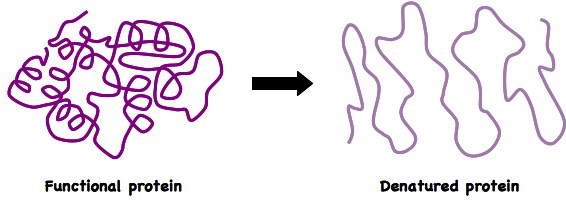
  • Denaturation
    • change in the structure of a protein


Image result for denaturing

Image result for macromolecules

Questions/ Reflections

  • I wouldn’t say this week has to relate to any of the big ideas directly, but will help  with understanding big idea 2, including “All living systems require constant input of free energy  *constant input of energy is necessary for full function of a system.”

Helpful Resources


Week 6 Learning

This week in AP Bio we started chapter 2 which is on chemistry. Most of it was review and we talked about energy, atoms, bonds, and water polarity. This connects with Big Idea 2.B, which states “Growth, reproduction and dynamic homeostasis require that cell create and maintain internal environments that are different from their external environments.”

Lecture: Bio- Chemistry 

Energy and Atoms

  • Atoms: the smallest fundamental unit of matter.
    • 120 different kinds of atoms (“elements”)
    • Biology is made up of 4 major, 10 minor.
  • Energy interacts with atoms in different ways.
    • Holds e-‘s to nucleus
    • When atoms absorb energy, e-‘s move to higher energy levels
    • The movement of e-‘s back to lower energy levels releases energy.

Atoms Bond

  • Bonding is accomplished by electrons interacting between atoms due to valence considerations. Two major kinds of bonds hold atoms together.
    • Ionic bond
      • Transfer of e-‘s
      • Not many combinations.
      • Example is salt, or, NaCl.
    • Covalent bond
      • Sharing of e-‘s
      • Infinite combinations
      • All important biological molecules are covalently bonded.
      • Example is glucose and DNA
  • Not all Bonds are created equal.
    • Polarity: the unequal sharing of electrons in a covalent bond leads to unequal distribution of charge in molecule. Polar molecules are attracted to other polar molecules.
    • Hydrogen Bonds: The strongest attraction between most polar molecules. Common in biological systems.
  • Bonds determine shape.
    • Shape is important.
    • Structure and function closely related.
  • All chemical reactions result in breaking and forming bonds. In any reaction, mass, energy, and charge are conserved.
    • 2H2 O2 = H20

Compounds and Emergence

  • The properties of a compound can be very different from properties of elements that make them.
  • Emergence: Increasing levels of complexity in a system can demonstrate novel properties not seen in the levels below them.
    • Example: Salt

Radioactivity

  • Atoms with unstable nuclei are “radioactive.”
  • Emit high energy particles until stability is reached.

Big Questions

  • Why is water such a big deal?
    • In our bodies, we are water
    • Earth has water
    • Unique properties such as polarity and hydrogen bonds.
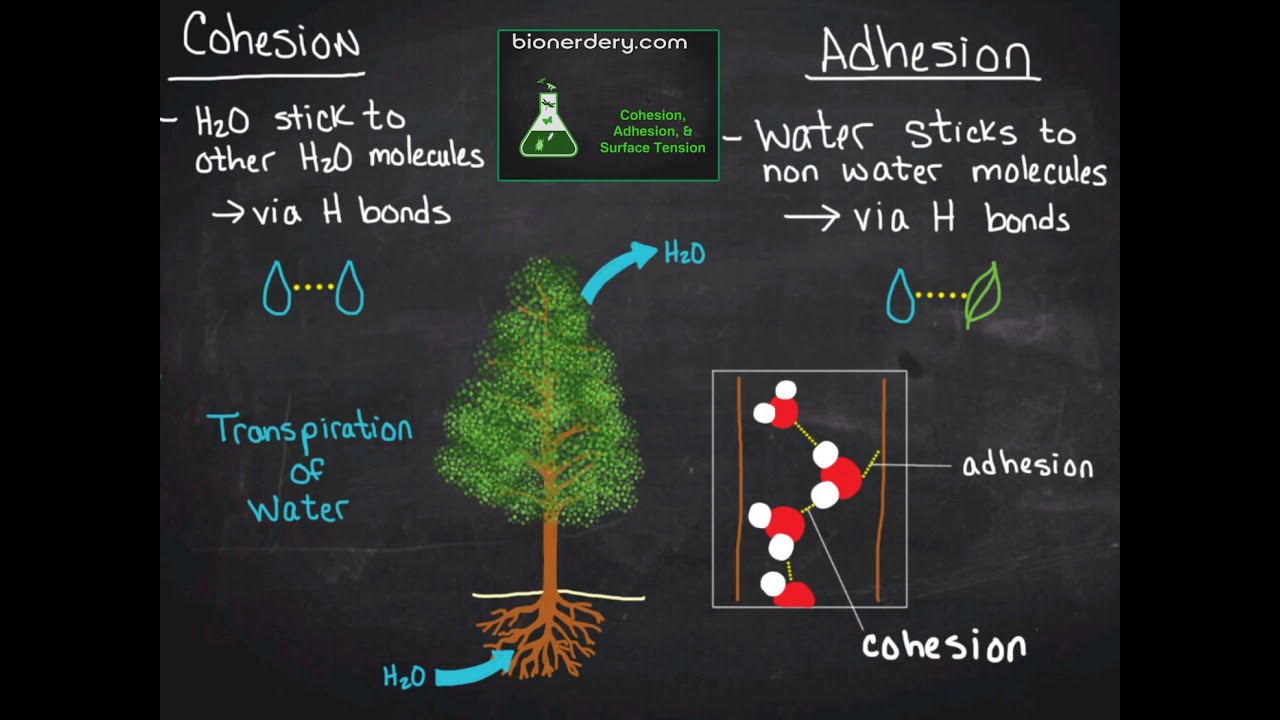
  • Cohesion: sticking together
  • Adhesion: Sticking to other things
  • Water is both cohesive and adhesive, which gives water high surface tension.

Image result for cohesion vs adhesion

A High Specific Heat

  • Specific heat: How much heat is absorbed/ released before an increase/ decrease in temperature.
  • There is no universal solvent but water comes close.

Reflection/ Questions

  1. How does the cohesion and adhesion of water help us?
  2. Are there other solvents that are as good/universal as water?

Helpful Links

https://www.khanacademy.org/science/biology/chemistry–of-life

Blog at WordPress.com.

Up ↑

Design a site like this with WordPress.com
Get started