Week 5 Learning


This week in biology we finished the Hardy-Weinberg population genetics lab and started our plant lab on artificial selection. The main focus of the week was speciation.

LECTURE: SPECIATION

  • Species: Members who interbreed and make viable offspring
  • Morphological: based on appearance
  • Ecology: based on niche
  • Paleological: based on fossils
  • Allopatric: Geographic barriers
  • Sympatric: Same area where species evolve for each otherImage result for speciation types allopatric vs sympatric


REFLECTION

  • Related to big idea number 1
    • The process of evolution drives the diversity and unity of life.
    • Speciation and extinction have occurred throughout the Earth’s history, speciation may occur when two populations become reproductively isolated from each other, and populations of organisms continue to evolve.
  • Speciation happens in nature, but scientists aren’t exactly sure how.
  • The idea of slow change over time is more excepted than the idea of rapid change followed by long periods of no change.

QUESTIONS

  • How was speciation discovered?
  • Can either theory of it be proved?

Helpful Links:

https://globalchange.umich.edu/globalchange1/current/lectures/speciation/speciation.html

Week 4 Learning

This week in AP bio we learned about measuring evolution and the Hardy-Weinberg theorem.

Lecture: Measuring Evolution 

  • Populations evolve, not individuals
    • Individuals are selected
    • The genetic makeup changes
    • Fitness increases
  • Variation
    • An organism has to be more fit than another in order for natural selection to take place.
    • Comes from mutations and sex
    • Mutation= random changes in the DNA
    • Sex= Mixing genes – new arrangements
  • Terminology
    • Gene= Determines a trait
    • Allele= A variation of a gene
      • Sexually produced organisms have two alleles
        • Dominant = The showing trait
        • Recessive = Only shows trait if both alleles are recessive
  • New Terminology
    • Homozygous= An individual who has two copies of the same allele
    • Heterozygous= Any individual who has one copy of dominant and onerecessive
    • Population= A local group of interbreeding individuals
    • Gene Pool= A collection of alleles in the population
    • Evolution= Change in allele frequency in population
  • Five Sources of Evolution
    • Mutation
    • Gene Flow
      • Movement of alleles and their alleles
        • Wind with seeds
        • Migration of animals
        • Reduces differences between populations
        • Modern Travel of humans
    • Nonrandom mating
      • Sexual selection
    • Genetic Drift
      • Chance events
      • Reduces variability
      • Founder effect, Bottleneck
    • Natural Selection

A good visual for Gene Flow:

flower

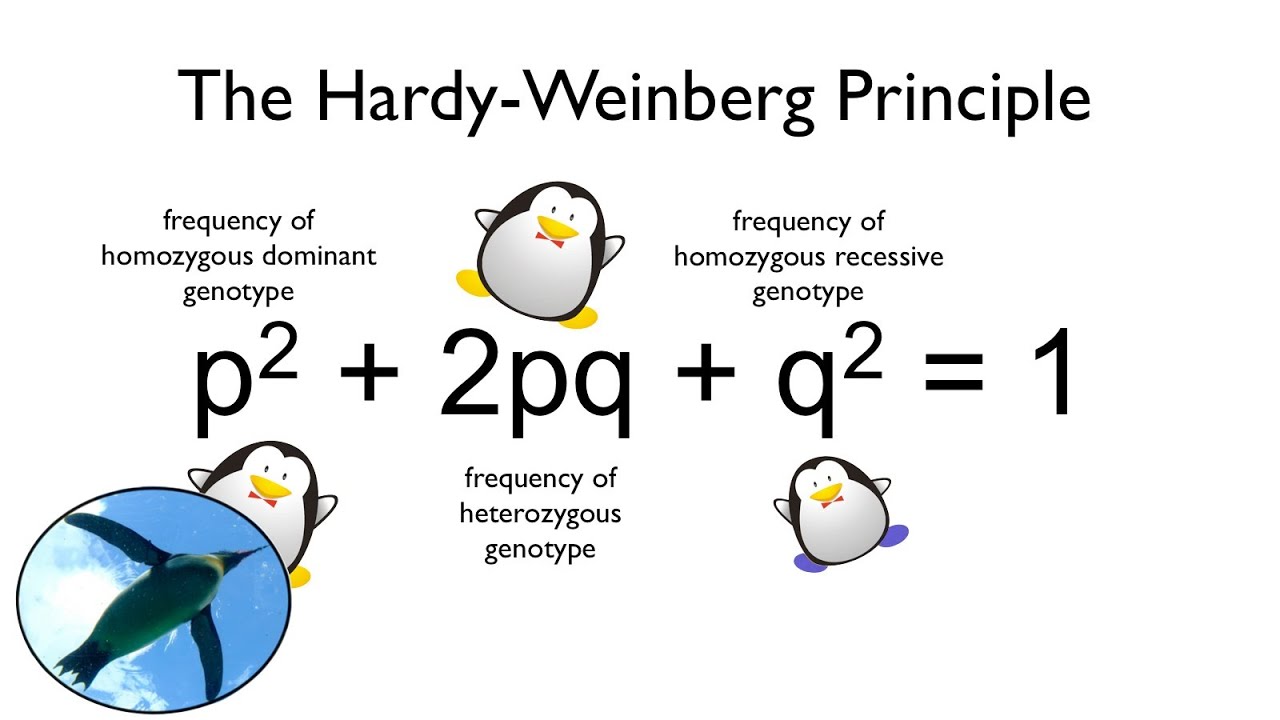
Hardy- Weinberg Theorem 

p² + 2pq + q²

  • p² = BB
  • 2pq= Bb
  • q² – = bb

Solving steps

  1. Write down both equations
  2. Identify any given information
  3. Don’t mess up squaring decimals
  4.  Figure out q²  or q
  5. Work your way around the problem

Image result for Hardy- Weinberg Theorem 

QUESTIONS

  • In what real-world situations is the theorem used?
  • What would cause allele frequencies to not change?


Sources:

https://www.khanacademy.org/science/biology/her/heredity-and-genetics/v/hardy-weinberg

Week 3 Learning

This week in biology we continued to learn about evolution mostly through lectures, and worksheets.

LECTURE: EVIDENCE FOR EVOLUTION

  • Falsifiability
    • Scientific thoughts can never be proven
  • Hypothesis
    • A testable statement about the universe
  • Theories
    • A major unifying framework supported by all evidence currently known
  • Laws
    • A deduced fact that will always hold true if given certain conditions

FOSSIL RECORDS

  • Isotopes are used to figure out how old an organism is based on the half life of the isotope.
  • Transitional Fossils
    • Show evolutionary links between groups of organisms
  • Homologous Record
    • Similar characteristics resulting in common ancestry
  • Analogous Record
    • Similarities in adaptations resulting from similar evolutionary pressures.
  • Vestigial Organs
    • Structures that serve little to no function

Image result for homologous vs analogous structures examples

LECTURE: MOLECULAR RECORD

  • Genetic Code
    • Universal code used by ribosomes
  • Building family trees
    • Closely related species are the same line of descent until their divergence from a common ancestor, this creates genetic differences
    • Fewer differences=more recently diverged
  • Genome sequences
    • All our genomes are sequenced
    •  23 chromosomes
  • Selection
    • Artificial
      • Selective breeding
      • Uses variations in the breed
  • Biogeography
    • Original evidence that informed Darwin
    • Organisms close to each other are found in similar areas

PHYLOGENIC TREES

  • Trace the path of evolution. Each “branch” of the tree is the development of a separate species.

Image result for Phylogenetic trees

QUESTIONS/COMMENTS

  • At what point is selective breeding illegal?

LINKS

Create a free website or blog at WordPress.com.

Up ↑

Design a site like this with WordPress.com
Get started